
India's August industrial output rose just 0.4 per cent compared with 2.4 per cent estimated in a Reuters poll.

The International Monetary Fund (IMF) on Tuesday slashed India's growth forecast for 2022-23 (FY23) by 80 basis points to 7.4 per cent, citing less favourable external conditions and rapid policy tightening by the central bank. In its update to the April World Economic Outlook, the IMF said that though a global recession in 2022 was ruled out with a growth estimate of 3.2 per cent, the balance of risks was squarely to the downside, driven by a wide range of factors that could adversely affect the global economic performance. "The risk of recession is particularly prominent in 2023, when in several economies growth is expected to bottom out, household savings accumulated during the pandemic will have declined, and even small shocks could cause economies to stall.

The airlines' losses globally are expected to be down from $52 billion in 2021 to $9.7 billion this year and industry-wide profit should be on the horizon in 2023, Director General of IATA Willie Walsh said in Doha on Monday. International Air Transport Association (IATA) represents some 290 airlines comprising 83 per cent of global air traffic. Walsh, in his inaugural speech at the 78th annual general meeting of IATA here, said that while the outlook for airlines globally is positive, the business environment remains challenging.

The economy is likely to register a 9.5 per cent growth this fiscal over 7.3 per cent contraction last year, as the ongoing recovery is faster and more credible than earlier foreseen, according to a foreign brokerage report. It will gather more momentum in the second half of the current fiscal, but will slow down to 7.7 per cent next financial year, it added. The government has budgeted for a 10.5 per cent growth this fiscal, but the Reserve Bank has scaled it down to 9.5 per cent.

However, Icra Rating Principal Economist Aditi Nayar feels that the numbers are a bit too optimistic and need real heavy-lifting by the Centre and the states. "The survey forecasts on real and nominal GDP will require a substantial push from Central and state spending as private sector capacity expansion is anticipated to be intermittent, and sector-specific in the next couple of quarters," she said. Nayar added that private consumption is likely to chart a differentiated recovery across income and age groups. Based on the comments made in the Survey, she expects the Union Budget to incorporate a growth in gross tax revenue of 15-16 per cent.

The finance ministry said on Tuesday that high energy and commodity prices due to the Russian invasion of Ukraine may provide an upside risk to inflation and continued vigil is required. "Going forward, elevated energy and commodity prices may act as an upside risk to the inflation outlook in the near-medium term. "Given the inherently unsustainable nature of high prices, international commodity prices are expected to level off early with an increase in supplies outside the crisis zone," the department of economic affairs said in its latest monthly economic report for February.

The Reserve Bank of India's rate-setting panel will go for a 0.35 per cent hike in the key repo rate at its meeting next week, an American brokerage said on Wednesday. The hike will be accompanied by a change in the policy stance to "calibrated tightening", Bofa Securities said in a report published ahead of the Monetary Policy Committee (MPC) resolution which is set to be announced on August 5. RBI has hiked the rate by a cumulative 0.90 per cent in two tightening moves in May and June, responding to the runaway headline inflation which has consistently overshot the upper end of the target set for the central bank for many months.

Markets this week would be guided by the ongoing quarterly earnings, macroeconomic data announcement and global trends, analysts said. The government will release industrial production data for June and inflation data for July this week. The RBI has revised its retail inflation forecast to 5.7 per cent, up from the earlier 5.1 per cent due to price pressure on account of supply constraints and high crude oil prices.

S&P Global Ratings has forecast India's economy to shrink by 5 per cent in the current fiscal. It, however, has projected GDP growth to be 8.5 per cent in 2021-22 and 6.5 per cent in 2022-23.
S&P Global Ratings on Tuesday affirmed India's sovereign rating at the lowest investment grade of 'BBB-' for the 14th year in a row with a stable outlook, and said that the country's strong external settings will act as a buffer against financial strains despite elevated government funding needs over the next 24 months. The sovereign credit ratings on India reflect the economy's above-average long-term real GDP growth, sound external profile, and evolving monetary settings, S&P Global Ratings stated. "India's democratic institutions promote policy stability and compromise, and also underpin the ratings. "These strengths are balanced against vulnerabilities stemming from the country's low per capita income and weak fiscal settings, including consistently elevated general government deficits and indebtedness," it said in a statement. S&P Global Ratings has forecast economic activity in India to begin to normalise throughout the remainder of fiscal 2022, resulting in real GDP growth of about 9.5 per cent.

After navigating the turbulent pandemic waves, the recovering Indian economy is now sailing through unchartered waters of rising coronavirus cases, spiralling commodity prices and spiking inflation though the lighthouse of sustainable growth remains visible. As 2022 begins, a raft of developments, ranging from Budgetary announcements to continuation of stimulus measures to monetary policy, will set the tone for the domestic economy, which is projected to grow more than 9 per cent in the current fiscal ending March 2022. The country's continuing massive vaccination drive and 'precaution' doses starting for select categories of people this month will provide a firewall against any steep spike in coronavirus cases amid the emergence of the Omicron variant.
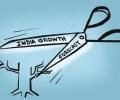
India's economy is projected to slow to 6.5 per cent in the fiscal year starting April but will remain the fastest growing major economy in the world as it fared better in dealing with the extraordinary set of challenges the globe has faced, the Economic Survey 2022-23 said on Tuesday. India's gross domestic product (GDP) growth of 6.5 per cent in 2023-24 compares with an estimated 7 per cent expansion in current fiscal year (April 2022 to March 2023) and 8.7 per cent in the previous year. Like the rest of the world, India too faced an extraordinary set of challenges in tightening financial conditions and supply chain disruptions from a prolonged war in Europe but "withstood them better than most economies", the annual document detailing the state of the economy said.

India retains the tag of the fastest growing country among the world's major emerging economies

Finance Minister Nirmala Sitharaman on Wednesday raised the personal income tax rebate limit, doled out sops on small savings and announced one of the biggest hikes in capital spending in the past decade as she did a tight rope walk in the Budget between staying fiscally prudent and meeting public expectations in the year before general elections.

The Survey lists some of the challenges that might impede India's progress.

The RBI projection of 6.9 per cent GVA growth for the current fiscal comes on the back of the Economic Survey last week forecasting economic growth of 6.5 per cent.

Strong macroeconomic headwinds causing turbulence in the $245-billion Indian IT industry are yet to calm down. Top Indian IT services companies are likely to post a decline or just marginal growth in sequential revenue in Q1FY24 because of a soft discretionary spending environment. Though the first quarter is seasonally strong for IT firms, "June 2023 will be an exception", according to analysts at Kotak Institutional Equities.

Fitch Solutions sees RBI keeping benchmark interest rates unchanged during the fiscal to March 2022 following its decision to buy Rs 1 lakh crore of government bonds. "We had initially expected another policy rate cut to arrest the rise in government bond yields since the Union Budget announcement in February. "However, having an explicit bond purchase guidance from the RBI following the announcement of the G-SAP will also achieve a similar effect, if not even be more effective than a rate cut on capping the increase in bond yields," it said in a note. The Reserve Bank of India (RBI) held its policy repurchase (repo) rate unchanged at 4 per cent at its monetary policy meeting on April 7.

Recent IMF forecast said China's growth is expected to slow down.

In its Fifth Bi-monthly Monetary Policy Statement, 2017-18, RBI said the second quarter growth was lower than the one that was projected in the October review, and the recent increase in oil prices may have a negative impact on margins of firms and Gross Value Added (GVA) growth.

The Centre for Monitoring Indian Economy on Thursday revised growth forecast for the country's economic growth upwards to 6.2 per cent in 2004-05 as against earlier estimate of six per cent.

'This is a period of significant uncertainty, of unknown unknowns.'

Reliance Industries raced to 52-week high on better than estimated earnings and announcement of bonus share.

Reserve Bank-sponsored professional forecasters on Monday scaled down India's growth projection to 4.8 per cent for the current fiscal from 5.7 per cent estimated earlier.

India, which appears to have been pushed back to being the world's sixth biggest economy in 2020, will again overtake the UK to become the fifth largest in 2025 and race to the third spot by 2030, a think tank said on Saturday. India had overtaken the UK in 2019 to become the fifth largest economy in the world but has been relegated to 6th spot in 2020. "India has been knocked off course somewhat through the impact of the pandemic. "As a result, after overtaking the UK in 2019, the UK overtakes India again in this year's forecasts and stays ahead till 2024 before India takes over again," the Centre for Economics and Business Research (CEBR) said in an annual report published on Saturday. The UK appears to have overtaken India again during 2020 as a result of the weakness of the rupee, it said.
Three months down the line, the National Council of Applied Economic Research has revised its forecast for the gross domestic product growth rate this fiscal by 0.3 per cent to 5.83 per cent due to better prospects in industrial outlook.

The Brics line-up has yielded to a shaky China-India story, with new question marks over China even as India remains a "B+" performer, says T N Ninan.
The government on Monday lowered the growth projection for the current financial year to 5.7-5.9 per cent from 7.6 per cent estimated earlier, while pitching for supportive monetary and fiscal policies to improve investor confidence.

The global lending agency also said that Brexit has resulted in global economic uncertainty.

The development of private data sources is a hugely positive development. It should serve as a challenge to the government to improve its own record on producing timely and reliable statistics, points out T N Ninan.

Corporate India is indicating cautious hiring in the March quarter of 2023 as concerns rise over possible recession and steady inflation, a survey said on Thursday. According to the ManpowerGroup Employment Outlook Survey, based on interviews with nearly 3,030 public and private employers, hiring intentions will decrease in the quarter both on year-on-year and quarter-on-quarter basis. During the quarter, 48 per cent employers expect to increase their staffing levels, 16 per cent anticipate a decrease in hiring intent and 34 per cent do not anticipate any change in hiring, resulting in a net employment outlook of 32 per cent.
The central government's fiscal deficit -- the difference between its total expenditure and receipts, excluding borrowings -- for 2006-07 has been reined in at 3.5 per cent of gross domestic product.

India's appetite for imported crude oil may wane in fiscal year (FY) 2023 from record levels in pre-pandemic 2019-20 fiscal as higher oil prices, a spillover from the conflict in Ukraine, and increasing use of biofuels affect domestic demand for petroleum products. Brent crude surged to a nine-year high, shy of a July 2008 record $147.50 a barrel, before declining to around $100 a barrel - but the volatility in commodity rates will slow global economic growth and use of fuels. Demand for all oil products may grow at only 2-3 per cent in FY23, slower than the current fiscal and nearly half the 5.5 per cent growth estimated by the petroleum ministry, according to industry officials.

Ahluwalia's assessment of economic growth is marginally higher than 6.3 per cent projected by the Commission earlier.

The Indian economy is likely to grow at over 7 per cent in the current fiscal year, former Niti Aayog vice chairman Arvind Panagariya said on Wednesday, while observing that the growth rate should sustain next year too provided the forthcoming Budget does not have any negative surprises. Panagariya further said recessionary fears have been around for a while but so far neither the US nor the EU has gone into recession. "From the viewpoint of India, in terms of headwinds originating abroad, the worst is probably behind us," he told PTI.

Banking, realty and capital goods sectors-- the sectors which are more interest sensitive and hence battered for long now--were the winners today.

The International Monetary Fund (IMF) on Tuesday said it is expecting some slowdown in the Indian economy next fiscal year and projected the growth to 6.1 per cent from 6.8 per cent during the current fiscal ending March 31. The IMF on Tuesday released the January update of its World Economic Outlook, according to which the global growth is projected to fall from an estimated 3.4 per cent in 2022 to 2.9 per cent in 2023, then rise to 3.1 per cent in 2024. "Our growth projections actually for India are unchanged from our October Outlook.

Former finance secretary Subhash Chandra Garg went on to say that the 2020-21 fiscal will go down in the history of India as the year when India got way-laid from its story of three decadal outstanding growth.

For 2021-22, it projected the economy to clock a growth of 10.6 per cent.

India's GDP is estimated to contract by a record 7.7 per cent during 2020-21 as the COVID-19 pandemic severely hit the key manufacturing and services segments, as per government projections released on Thursday. Amid overall decline in economic activities, some respite was provided by the agriculture sector and utility services like power and gas supply, which have been projected to post positive growth during the current fiscal ending March 2021.
